Where to stand
On Yoshi Sodeoka's 21.000 and 21.000 II

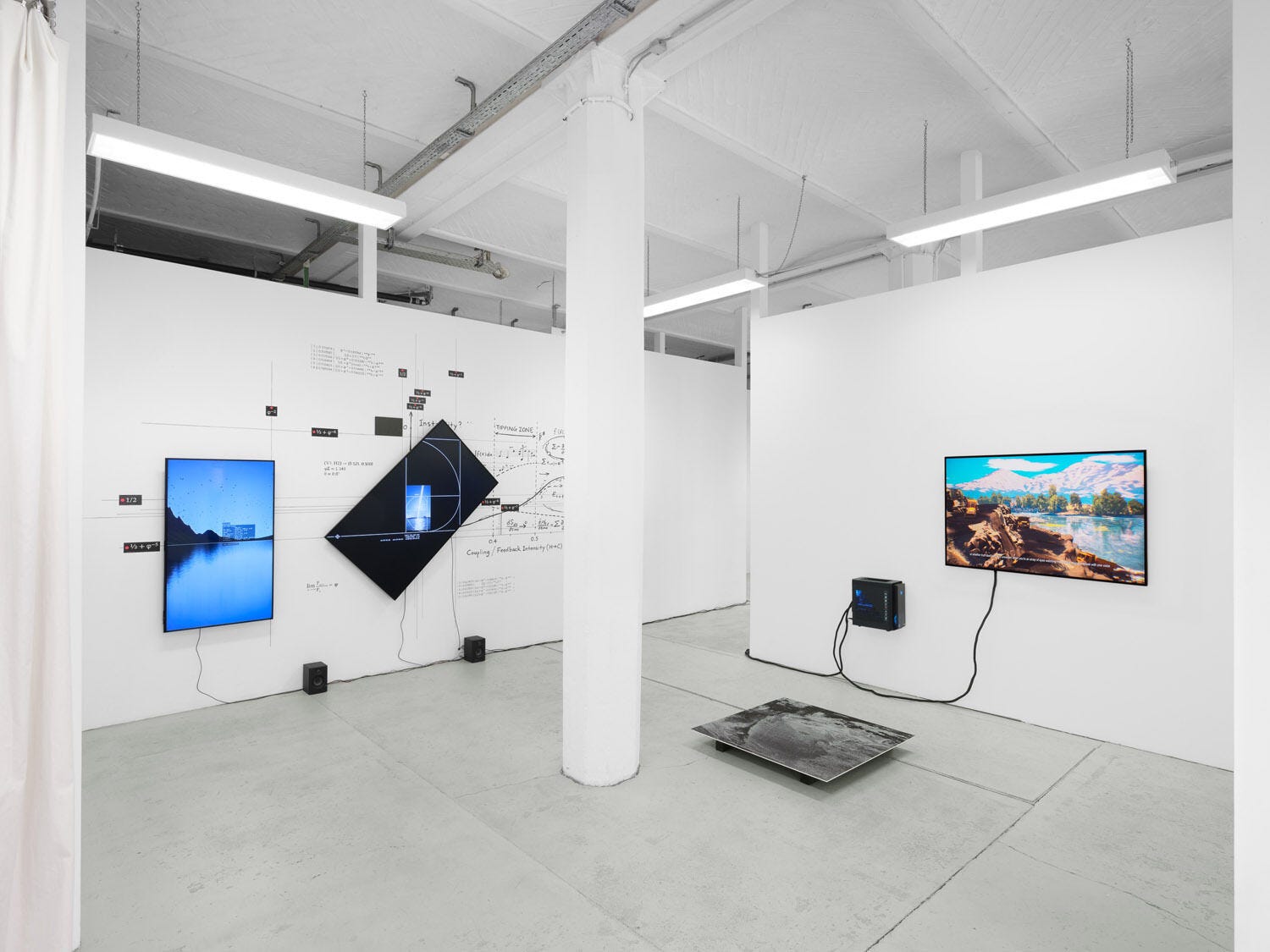
*drifts; OFFICE IMPART Installation, Yoshi Sodeoka “21.000 II” (https://officeimpart.com/drifts)
Within six weeks, in two galleries on opposite sides of the world, Yoshi Sodeoka exhibited two unique works that share a name and a conceptual seed but split, sharply, into different philosophical positions.
21.000 opened at NEORT++ in Tokyo in December 2025, in Patterns of Entanglement, co-curated by Alex Estorick and Yusuke Shono. 21.000 II opened at OFFICE IMPART in Berlin in January 2026, in drifts;, with text by Stina Gustafsson, an independent curator working at the intersection of art and emerging technologies.
Both unique. Both built around a decade of footage of the sun. Both pulling the layered processes of digital production into physical space. The titles announce them as siblings.
But the questions they ask of the viewer are not the same. One asks how nature appears. The other asks when the system collapses. This essay is about that split, what it suggests about Sodeoka, and what it might suggest about the moment we are in.
The exhibition that started this
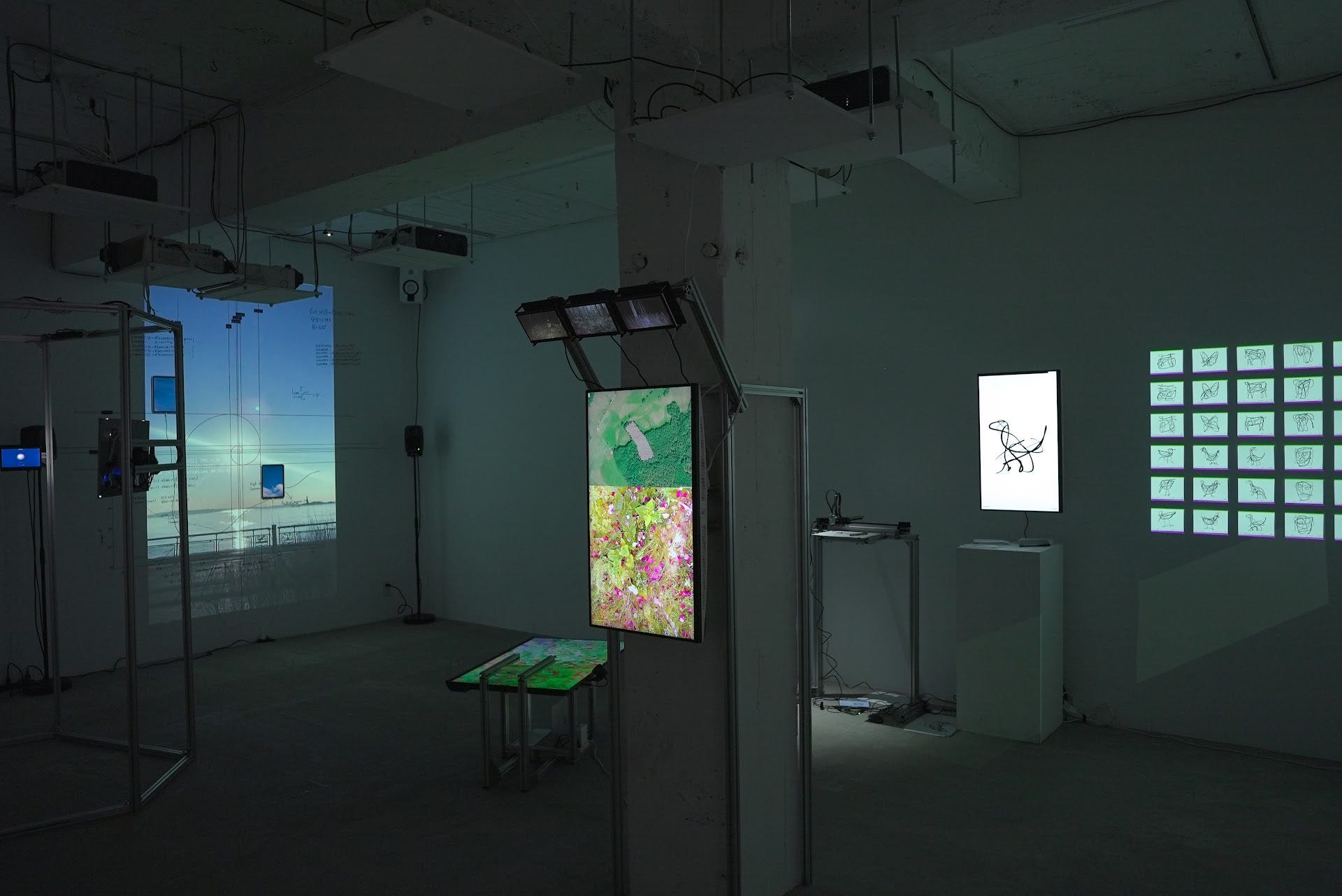
*Yoshi Sodeoka "21.000" in Patterns of Entanglement, NEORT++ (https://two.neort.io/ja/exhibitions/patterns_of_entanglement)
In December 2025, NEORT++ presented Patterns of Entanglement, co-curated by Alex Estorick and Yusuke Shono. Ten artists were invited to think past anthropocentrism, into a space where digital and natural ecosystems intersect. The framing was media ecology: the world understood as a site where ethical, ecological, and technological processes constantly regenerate and transmit.
Sodeoka’s contribution was 21.000. The exhibition closed at the end of December. A few weeks later, Berlin saw the second.
The two works did not arrive in this proximity by accident. They are two articulations of an inquiry Sodeoka has been pursuing for years, which only now is taking a form that requires more than one piece to hold.
Why Yoshi Sodeoka
In a 2019 interview for MASSAGE Magazine, conducted by Yusuke Shono, six years before either of them knew they would co-curate a show together, Sodeoka described how he came to video as his medium.
It was around 1995. I started with an internet art project called Word.com. A multimedia site where you could view GIFs and videos. I worked on it as art director for about five years. But technology changes so fast. Work I made one year before would stop being viewable when the browser updated. There was software called Shockwave that I used a lot, and then it became unusable. That happened often, and it was a real source of frustration. So I started to think that maybe video was the better medium for what I wanted to express.
Video is simple, fundamentally. Even if QuickTime disappears, converting to another format isn’t that difficult. And I didn’t want to be at the mercy of software companies. They prioritize economic decisions. I’d rather do what I believe in myself. So I started focusing on video. In 2001, I made a DVD collection. I self-published, because nobody else was doing that kind of thing at the time. I gathered the money, asked the DVD company that publishes Harry Potter to master it. It was unusual then, so it sold in Japan, got covered in magazines. The DVD era is over now, of course. I released a second one around 2004.
Source: themassage.jp/archives/11211
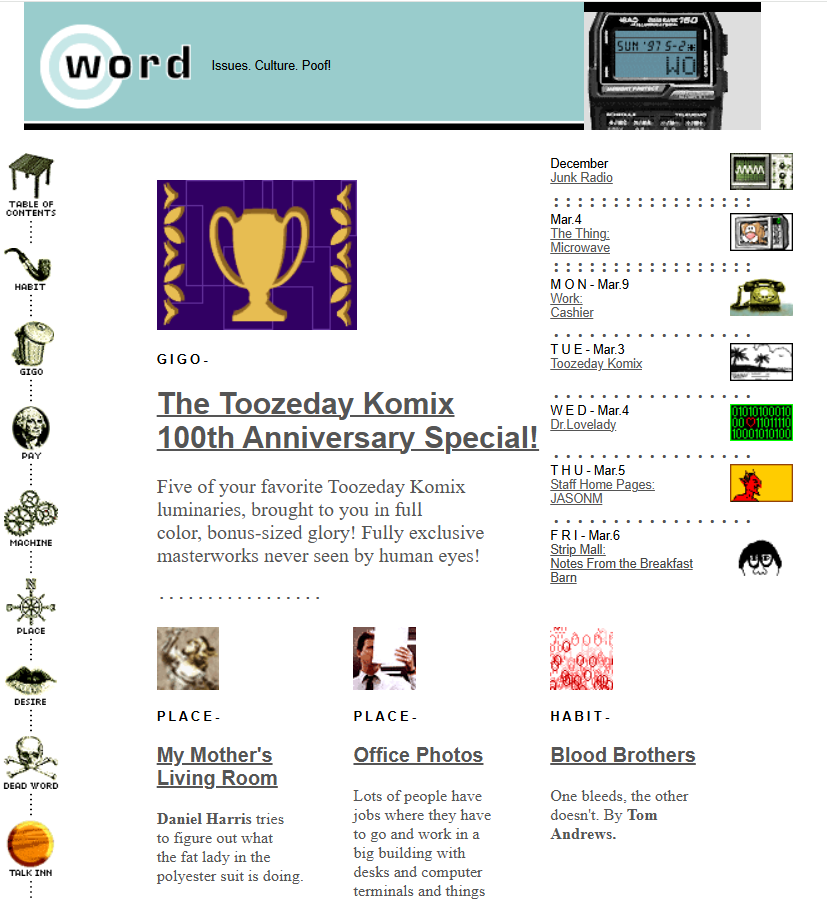
*DEADWORD.COM is an historical archive of Word Magazine (then www.word.com) from 1995 to 1998. (https://deadword.com/)
Read the passage carefully. The decision to commit to video was not aesthetic, it was philosophical. Sodeoka watched his early Word.com work disappear when browsers updated and Shockwave was discontinued, and he drew a conclusion that has shaped the next twenty-five years of his practice: don’t entrust your work to platforms whose first priority is economic.
What is striking, in the longer view, is that this was a question about preservation made twenty-five years before digital art preservation became a market consideration. He was already living the question collectors are now starting to ask.
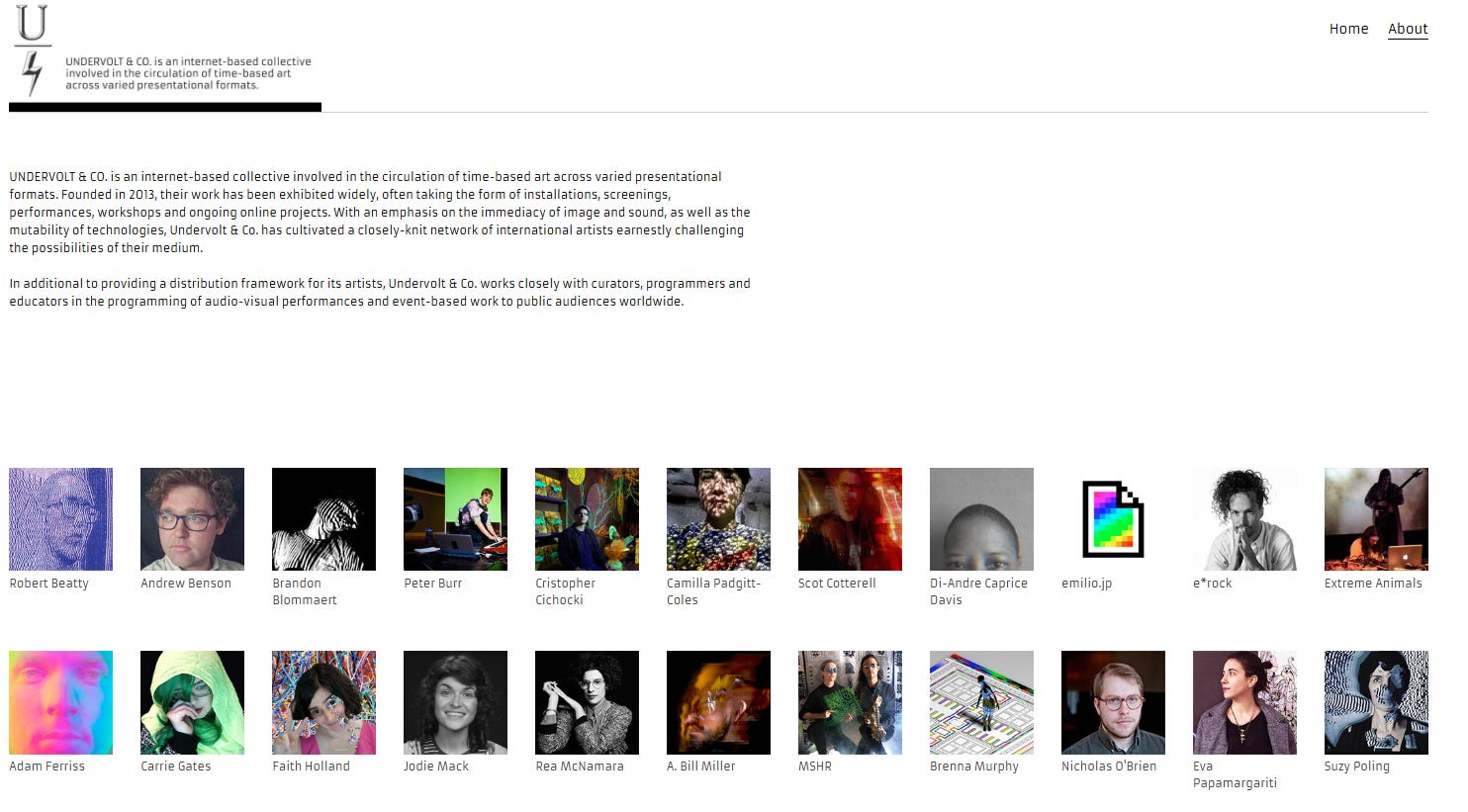
*Undervolt & Co. (https://www.undervolt.co)
The arc since is consistent. Video as the spine. The 2001 DVD, self-published because no one else would do it. Undervolt & Co. founded in 2013, a label built, where we can see artist like emilio.jp, for video work that streaming platforms could not properly hold. There is a particular irony in what came after: Word, the very e-zine whose disappearance into obsolete browsers drove him to video in the first place, was acquired by the San Francisco Museum of Modern Art for its permanent collection. The work he watched vanish became, in the end, what institutional memory chose to keep.
His practice now sits in the permanent collections of SFMOMA, the Museum of the Moving Image, and the Whitney Museum of American Art. Exhibitions through Centre Pompidou, Tate Britain, the Cleveland Museum of Art, Deitch Projects, La Gaîté Lyrique, and the Baltimore Museum of Art. Editorial commissions from The New York Times, Wired, The Atlantic, and MIT Technology Review. Music videos for Tame Impala, Oneohtrix Point Never, Beck, and Metallica.
For Sodeoka, moving between analog and digital is not a stylistic device. It is the embodied form of his philosophy. He confronts the moment he is in, and pursues his own style inside it.
What 21.000 is
*Yoshi Sodeoka ”21.000" NEORT, verse (https://verse.works/series/21-000-by-yoshi-sodeoka)
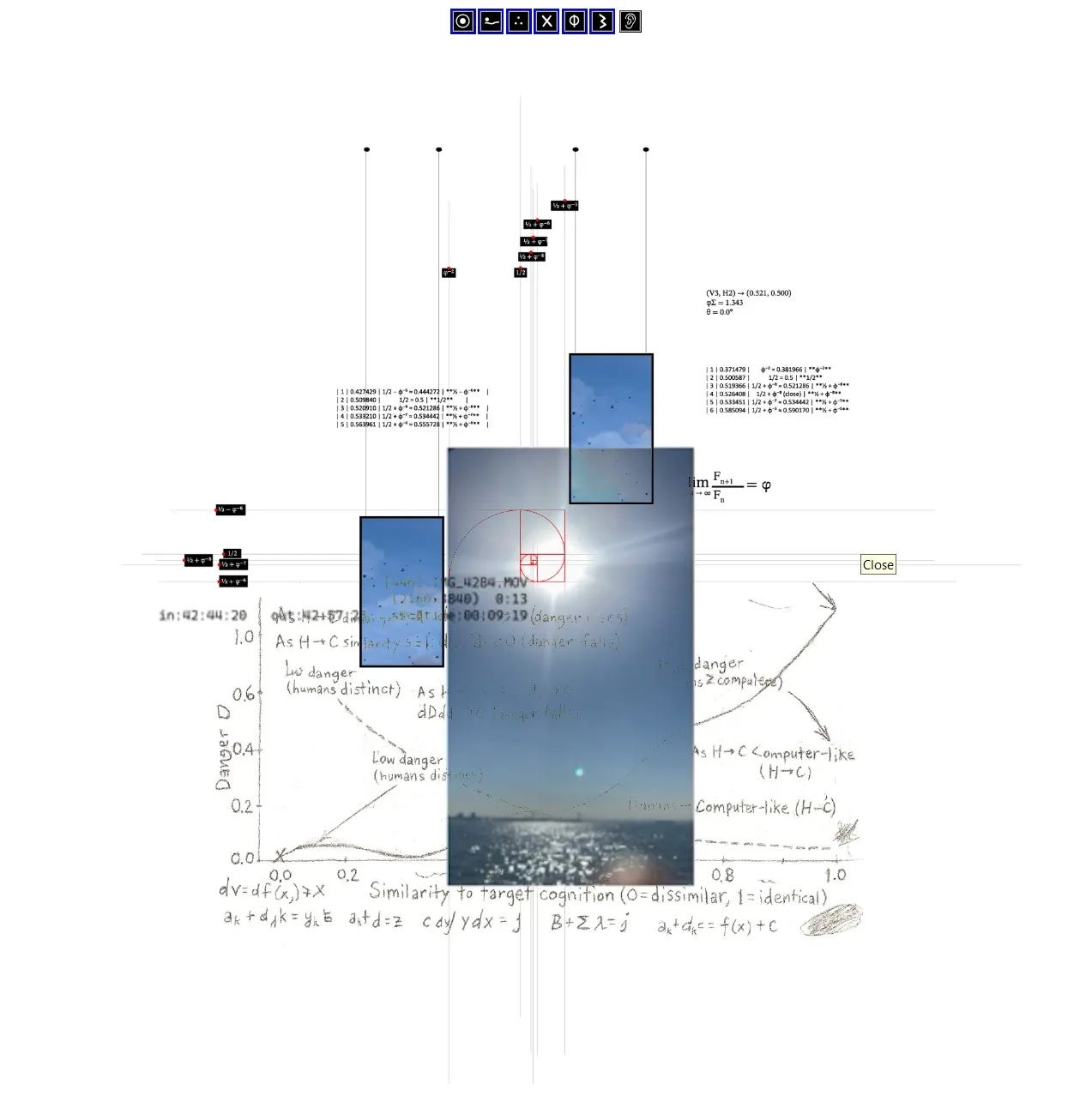
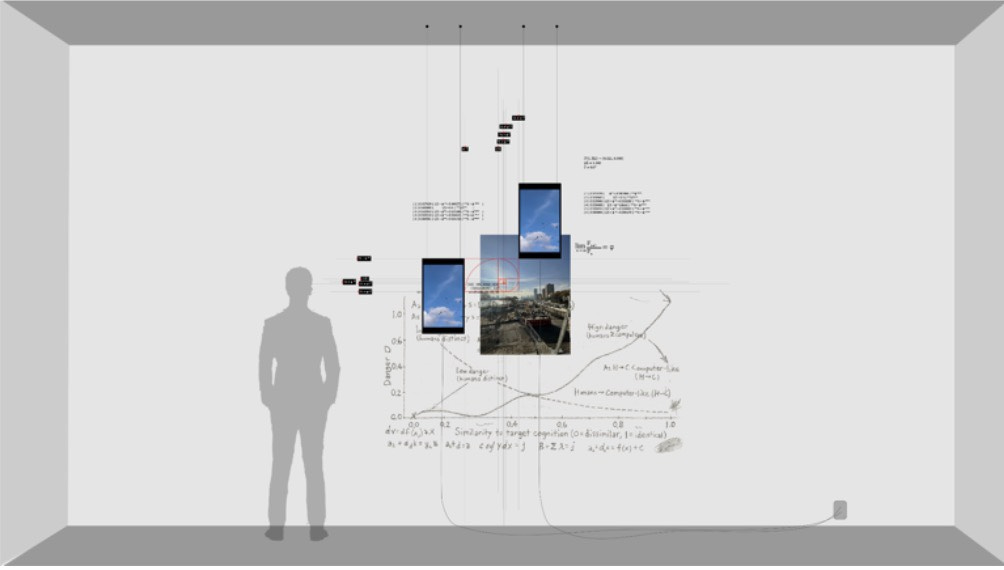
21.000 takes the layered processes of digital production and brings them into physical space. The work draws from an archive of sun footage Sodeoka has been recording for more than a decade, in parks and across the streets of New York, on a succession of smartphones. The sun, always centered in the frame, projected onto a wall. A golden-ratio grid drawn directly onto that wall, alongside mathematical notations. Loose, graffiti-like hand marks that sit beside the precise geometry. Moving images of sky and birds on separate digital surfaces in the room.
For Sodeoka, nearly three decades of working with the internet and digital creation has meant constantly adapting to platform specifications and technical constraints. As the platform landscape grows increasingly chaotic, this work represents a deliberate step away, a desire, in my words, to touch the grass, and to articulate his digital expression within physical space.
There is something worth pausing on in that archive. A decade of an artist walking through a city, holding up whichever phone he had at the time, pointing it at the sun. Not a project conceived as a project, but a habit that became one. The same gesture, repeated across changing devices, changing seasons, changing parks. The work that emerges from that accumulation is not about any single video. It is about the rule that governed all of them: center the sun, press record.
Why the sun. Sodeoka has been asked this directly. In an interview with Lonliboy for Verse, he answered:
In my videos, the sun implies power and majesty. But I don’t mean that religiously or spiritually. The idea is more scientific. The sun provides energy and life.
*From Skydomes to Simulations: Interview with Yoshi Sodeoka (https://verse.works/journal/interview-with-yoshi-sodeoka)
That answer is worth holding onto. The sun in 21.000 is not a metaphor for the divine, not an icon, not a sublime object in the Romantic sense. It is the energy source. The condition that makes life, and, by extension, the camera, the phone, the city, the artist , possible. To center the sun in the frame for ten years is not a spiritual practice. It is a scientific commitment. An acknowledgment that everything else in the image, including the eye looking through the lens, depends on it.
The result is a quiet tension between calculation and improvisation. Layers that normally stay hidden inside a screen, calculations, sketches, notes, moving images , coexist in the same physical space.
*An image of Instruction direction from Yoshi Sodeoka
While 21.000 was on view at NEORT++ in December, I caught myself calling it, in conversation, a Wall Drawing that included video. The phrase came out before I’d thought it through, and I left it alone. It was reaching for something. The structural grammar of the piece is unmistakably LeWittian: delegation of physical execution, exposure of intervening steps, rules set in advance that govern the work, refusal to fetishize material. The Wall Drawings are the obvious reference.
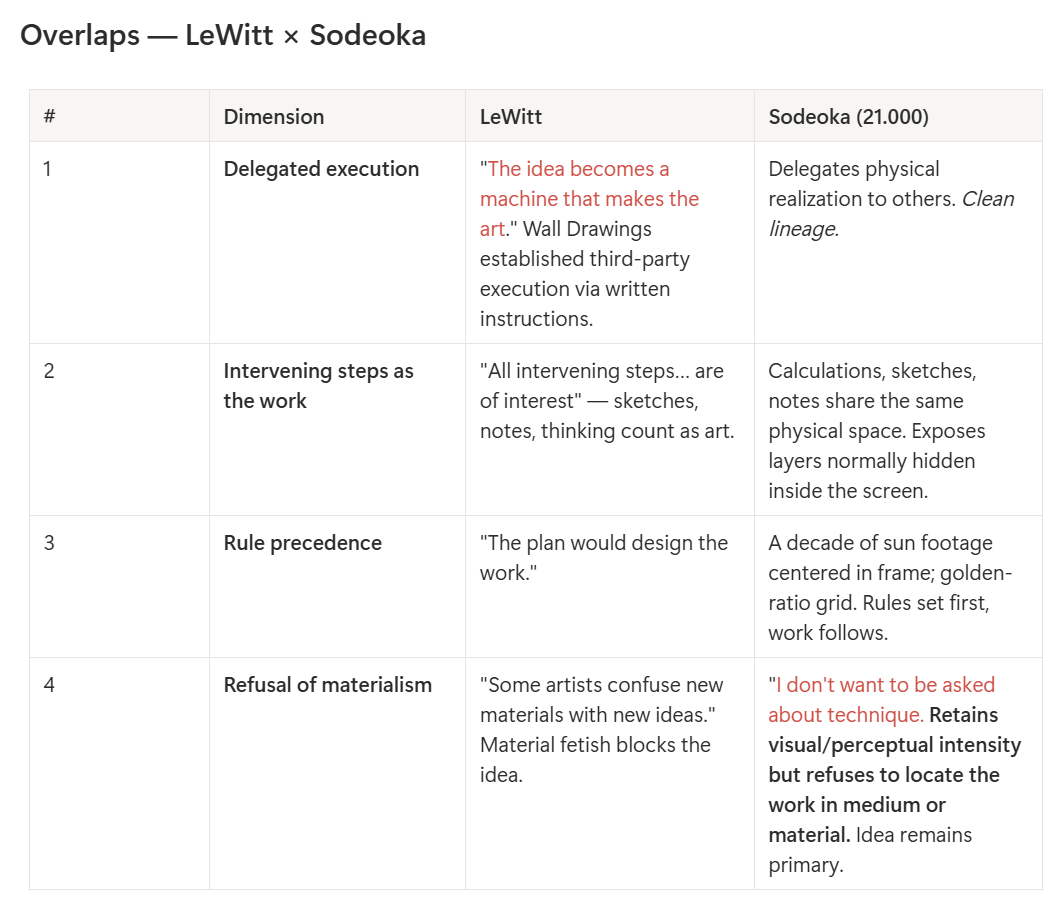
But the production process inverted LeWitt’s logic. 21.000 did not begin with instructions to be executed. It began as a conversation about how to give physical embodiment to convert them to the digital world, having Sodeoka and Yusuke Shono in the conversation. The work was developed materially: poster paper, stickers, iPads, repeated trials in the gallery space, with the Wall Drawing as conceptual reference rather than executable specification. Out of that physical experiment came Shono’s proposal: encode the layers as seven toggleable elements, one of them carrying sound, so that a collector or viewer could touch the same logic in digital space. The digital form of 21.000 was not specified in advance. It surfaced from the body of the physical installation, and only afterward could be translated back.
This is what makes the LeWitt comparison both accurate and incomplete. The grammar is shared; the direction of travel is reversed. LeWitt’s instructions preceded the work. Here, the structure was discovered in the gallery through material trial, and only afterward became something the digital expansion could follow. The piece does not just travel from the digital to the physical. It loops, because the physical experiment produced the digital it loops back to.
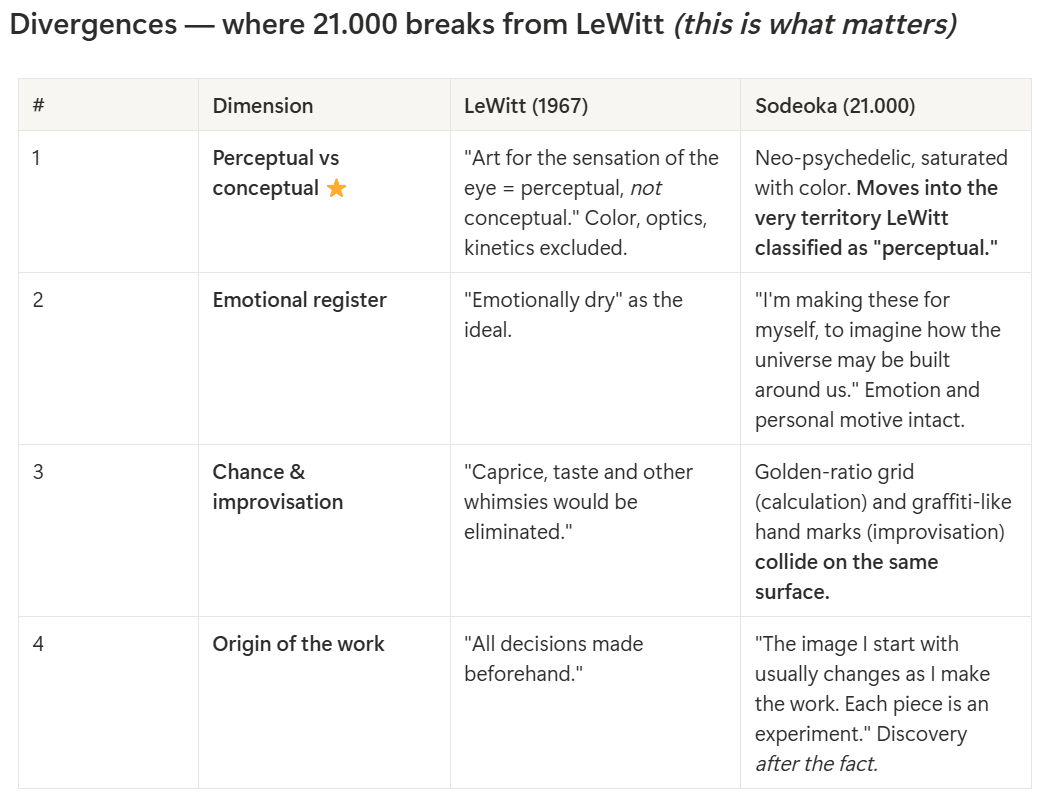
And 21.000 reintroduces the four things LeWitt sought to evacuate from conceptual art in his 1967 Paragraphs on Conceptual Art: perceptual pleasure, emotional warmth, improvisation, and the discovery that happens during making rather than before it. It is not a faithful descendant of 1967 conceptualism. It is conceptualism rebuilt to hold a body. A position native to the digital era, where the screen has become a new site of embodiment, and where math and sensation no longer have to be enemies.
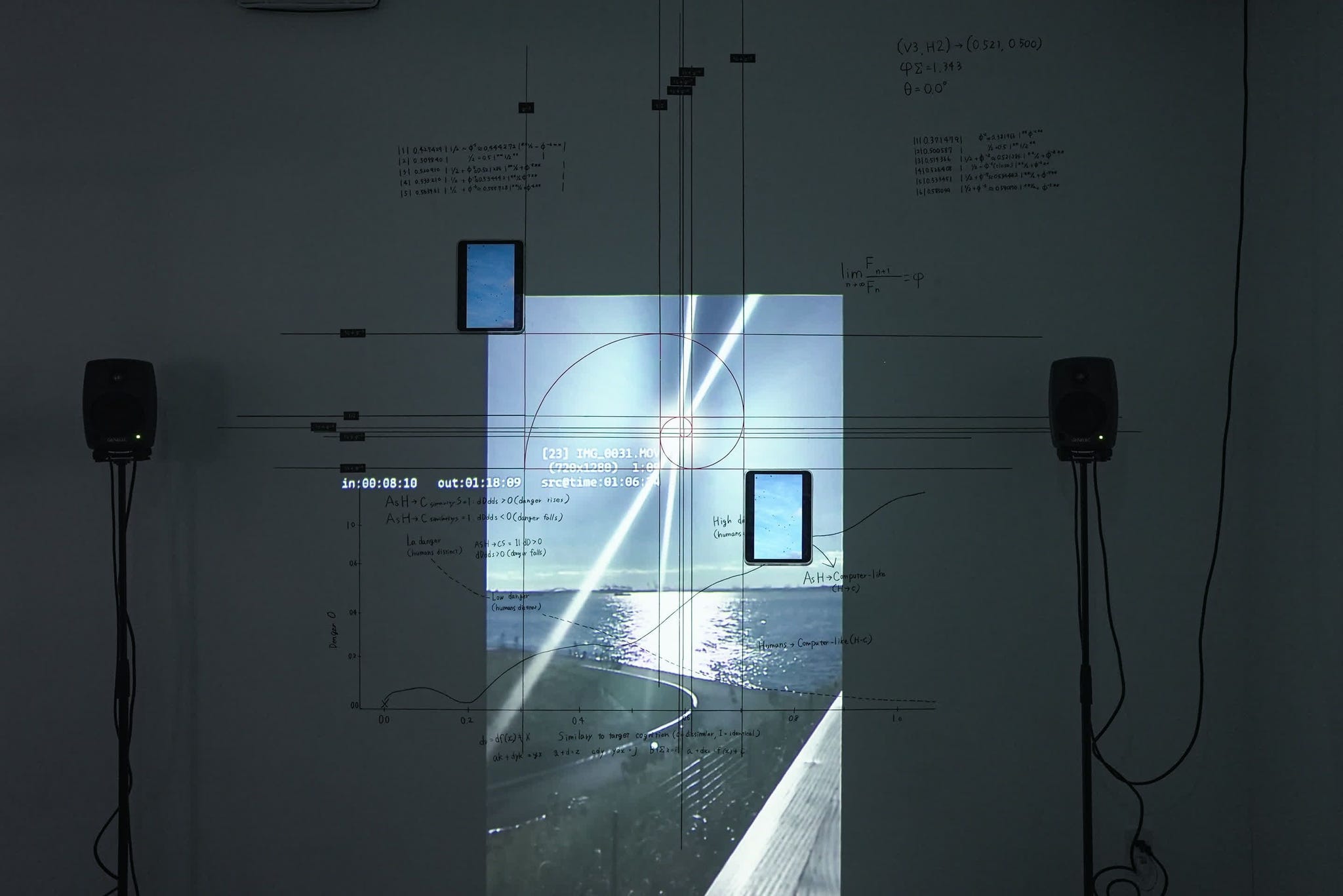
*Yoshi Sodeoka “21.000” NEORT++ Patterns of Entanglement
This is the position 21.000 takes. It takes it on a single wall, in a frontal, contemplative format. The viewer stands in front of it and observes. The work invites observation in the classical sense: subject and object, cleanly separated. You watch the sun. The sun does not watch you.
For those who have followed Sodeoka’s practice, 21.000 reaches something like the wellspring of his creativity. It reveals the origins of pieces like The Swarm and his hypertimelapse works, the same instinct, traced back to its source. The pioneering spirit of this internet street explorer, walking the city for a decade with his phone pointed at the sun, continues to push forward.
Then 21.000 II
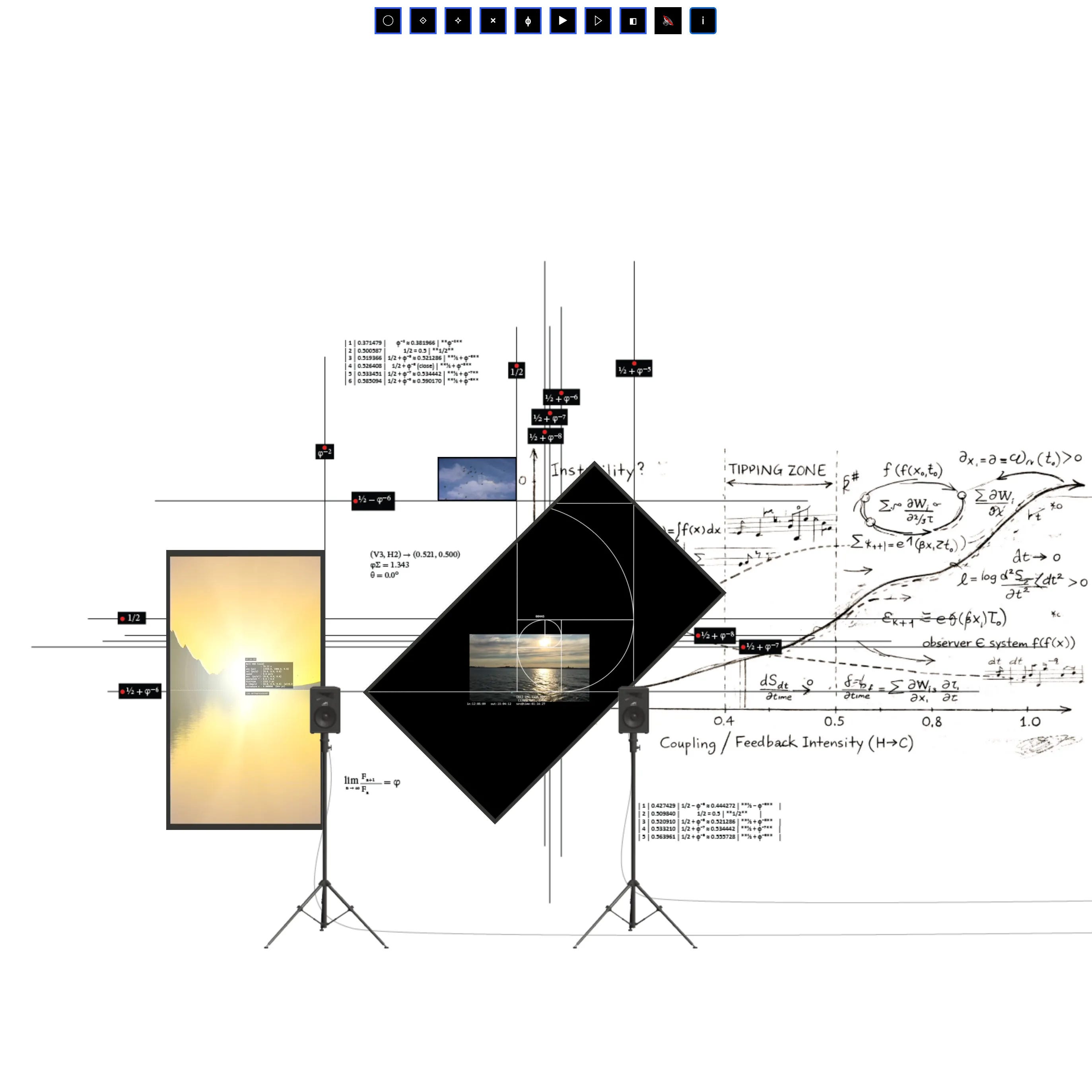
*Yoshi Sodeoka “21.000 II”, OFFICE IMPART, verse (https://verse.works/series/21-000-ii-by-yoshi-sodeoka)
Six weeks later, in Berlin, the same conceptual seed grew differently.
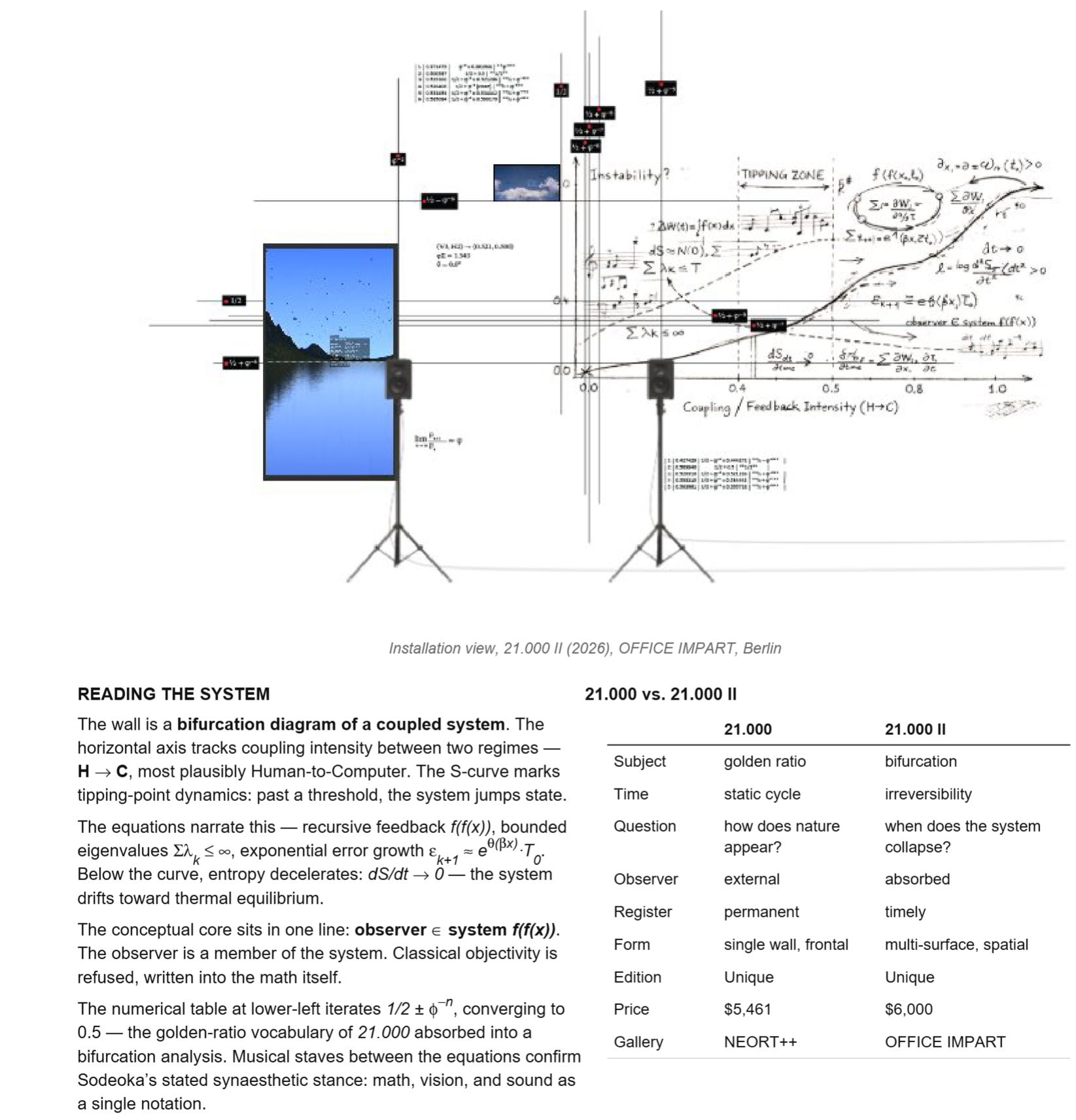
21.000 II spreads across multiple surfaces, walls, floor, a tilted screen, a reflective panel. The mathematics on the wall is no longer the golden ratio. It is the bifurcation diagram of a coupled system. The horizontal axis tracks coupling intensity between two regimes, labeled H → C, most plausibly Human-to-Computer. An S-curve marks tipping-point dynamics. There is a region annotated TIPPING ZONE. Past the threshold, the system jumps state. Below the curve, the math says dS/dt → 0 — entropy decelerates, the system drifts toward thermal equilibrium.
The numerical table at lower left is doing something quietly remarkable. It iterates ½ ± φ⁻ⁿ, where φ is the golden ratio, and shows the sequence converging to 0.5. The vocabulary of 21.000 is still here, but it has been folded into a bifurcation analysis. The classical pattern absorbed into a question about transition.
Read as a whole, the piece is a single proposition rendered in three notations at once ,mathematics, image, and music: a system in which humans and computers are coupled together, depicted at the moment it crosses a critical threshold and jumps into a new state, showing that we ourselves, the observers, are situated inside that very system.
And on the wall, the line that gives the whole piece its center of gravity:
observer ∈ system f(f(x))
The observer is a member of the system. The notation f(f(x)) , a function applied to its own output, signals the recursion: what the observer measures feeds back into what is measured. There is no neutral place to stand.
This is the move that distinguishes 21.000 II from 21.000. In 21.000, the viewer is external, observing a cosmological pattern from a contemplative distance. In 21.000 II, the viewer is absorbed, the equations describe the very condition the viewer is inside of. The piece does not allow you to stand neutrally and watch. You are the H in H → C.
The classical scientific stance, Galileo watching a pendulum, the viewer separated from what they observe, has been refused. Twentieth-century science kept running into the limits of that stance. Quantum mechanics: measuring a particle changes its state. Cybernetics: feedback loops mean the observer’s interventions reshape the system they are trying to understand. Ecology: studying climate while contributing to it. The shift from external to absorbed is one of the defining intellectual movements of the last century. 21.000 II writes it directly onto the wall.
One production detail confirms the move. 21.000 used projection, light cast onto a wall, dissolving into the same surface that held the golden-ratio grid. 21.000 II uses screens. Two of them, arrived at through conversation with the gallery, which preferred discrete displays to projection. A projection is light landing on architecture; the wall remains the primary surface. A screen is a device, a node, light comes from a thing, not onto one. In a work whose central proposition is observer ∈ system, the screen stops being a neutral display surface and becomes a piece of the system being diagrammed.
This was not an idiosyncratic call. OFFICE IMPART’s curatorial program treats the materiality of technology, the texture of devices, the networks that carry digital work, the labor of care that keeps it visible, as a substantive concern rather than background infrastructure. The screen decision came from that position, and that it aligned so exactly with what 21.000 II was saying about the observer being part of the system was not coincidence.
The collaboration ran deeper than the screens. The production methodology developed at NEORT++ was shared with OFFICE IMPART before 21.000 II was made, and the encoded layer structure was carried forward and extended. 21.000 in Tokyo had seven toggleable layers, one of them carrying sound. 21.000 II in Berlin has ten. The expansion is not decoration; it is the trace of a second institution taking the structure that emerged in Tokyo and pushing it into territory it had not yet entered.
The split
What is interesting is that one artist made both works in such close succession.
The same hand drawing the golden-ratio grid in Tokyo and the bifurcation curve in Berlin. The same decade of sun footage rendered, in one case, as a pattern to be contemplated, and in the other, as a measurement entered into a dynamical system whose stability is in question. Two questions that pull in opposite directions: how does nature appear, and when does the system collapse. The first is permanent. The second is acutely now.
This kind of split is rare, and worth taking seriously. It suggests that Sodeoka is working through something that does not resolve into a single question. It also suggests that the moment we are in is asking artists to occupy two registers at once, the timeless and the timely, and that some of them are choosing to articulate both rather than collapse one into the other.
Hold the two works together and a particular kind of duality becomes visible. Sodeoka’s quarter-century of insistence on platform independence, his philosophical commitment to formats that survive their own moment, finds itself in tension with a work that explicitly thematizes transition, irreversibility, the collapse of stable states. The artist who refuses to be at the mercy of software companies is now making work about the larger system that those companies sit inside, and asking whether anyone, including himself, can stand outside it.
21.000 holds the position that some questions remain stable across time. 21.000 II holds the position that some questions are only legible from inside the moment they are asked. They are neither competing nor identical. They are two faces of an inquiry that does not yet have a single answer, made by an artist clear-eyed enough to refuse to pretend it does.
A closing thought
The title of this essay is “Where to stand.” The two works answer differently. 21.000 gives you somewhere to stand: in front of the wall, eyes on the sun, the work and the viewer arranged in the classical configuration. 21.000 II removes the place. observer ∈ system says you cannot find an outside. The H in H → C is not a position, it is the condition you arrived in.
So where to stand is, in the end, the wrong question. The right one is: what does it mean to write essays, to hold work, to make decisions about value, while standing on the absorbed side of the threshold the second work depicts? Sodeoka does not answer this. He puts the equation on the wall and leaves the rest of us to notice we are inside it.
Glimmer DAO holds 21.000. We are in dialogue with it daily. 21.000 II remains in the world, its question open. We are inside its diagram, whether or not we look up to read it. 🔅
Title: 21.000 II
Platform: Verse
Presented by OFFICE IMPART
Price: $6,000
Blockchain: Ethereum
https://verse.works/series/21-000-ii-by-yoshi-sodeoka
Yoshi Sodeoka
Yoshi Sodeoka is an artist working across video, print, and digital media, with a practice that includes immersive video installation. His work explores the boundaries between perception, abstraction, and systems logic, drawing from experimental music culture and the structural language of math and digital technology.
Through generative processes and layered time-based compositions, Sodeoka creates visual experiences that shift between intensity and calm, chaos and order. His aesthetic often incorporates diagrammatic overlays, lines, vectors, symbolic forms, that evoke how machines attempt to read the world, while embracing ambiguity and contradiction. The result is a visual language that feels both engineered and intuitive.
His projects span fine art, editorial, and music contexts. He has collaborated with musicians such as Metallica, Psychic TV, Tame Impala, Oneohtrix Point Never, Beck, The Presets, and Max Cooper. His illustrations have appeared in The New York Times, Wired, The Atlantic, and MIT Technology Review. He has also been commissioned as an artist by brands such as Apple, Samsung, Adidas, and Nike.
Sodeoka’s work has been exhibited internationally at venues including the Centre Pompidou, Tate Britain, the Cleveland Museum of Art, Deitch Projects, La Gaîté Lyrique, the Museum of the Moving Image, the Baltimore Museum of Art, and Laforet Museum Harajuku. His work is in the permanent collections of the Whitney Museum of American Art, the Museum of the Moving Image, and SFMOMA.
Originally from Yokohama, Japan, he moved to New York in the 1990s to study at Pratt Institute and has been part of the city’s art scene since.
NEORT++
NEORT is supporting the connection between artists who use digital technology and society. In April 2022, NEORT++ an exhibition space specializing in digital art opened in Bakurocho. We aim to create new art experiences between online and offline.
OFFICE IMPART
OFFICE IMPART, founded in 2018 by Johanna Neuschäffer and Anne Schwanz, is a Berlin gallery focused on digital and post-digital practice, working across both physical and online formats. drifts, with curatorial text by Stina Gustafsson, opened in January 2026.